
When Is Back Pain Serious? Warning Signs You Shouldn’t Ignore

Back pain is one of the most common complaints we see and in most cases, it resolves on its own with rest and a little time. But when is back pain serious? That’s the question too many people wait too long to ask.
Some back pain is routine. Some are a signal that something deeper needs attention. Knowing the difference can protect you from chronic damage, nerve injury, and a much longer road to recovery.
Most Back Pain Is Not Serious – Understanding What’s Normal
Let’s start with reassurance. The vast majority of back pain episodes are mechanical – caused by muscle strain, overuse, poor posture, or a minor awkward movement. These cases typically resolve within a few days to a few weeks with rest, gentle movement, and conservative care.
The body is remarkably good at healing itself when the issue is minor. But not all back pain follows this straightforward path and that’s when closer attention matters.
7 Warning Signs Your Back Pain May Be Serious
1. Pain That Lasts Longer Than 2 to 4 Weeks
Acute pain that doesn’t begin to meaningfully improve within 2–4 weeks has crossed into a different category. At this point, the body is telling you that something isn’t self-correcting. Persistent back pain causes ranging from disc involvement to structural misalignment are common drivers and they don’t resolve with rest alone.
2. Pain That Radiates Down the Leg
Pain that travels from the lower back into the buttock, thigh, or calf is a classic sign of nerve involvement – most often sciatica from a herniated disc pressing on the sciatic nerve root. This is not a muscle problem. Radiating pain needs proper evaluation to understand which nerve is affected and why.
3. Numbness, Tingling, or Weakness
Any combination of pins and needles, reduced sensation, or actual muscle weakness in the legs or feet is a neurological red flag. These symptoms suggest nerve compression that, if left untreated, can progress to more significant or lasting nerve dysfunction. Don’t wait on these.
4. Severe Pain After an Injury or Accident
A fall, car accident, or sudden trauma to the spine warrants prompt evaluation – even if you initially feel “okay.” Adrenaline masks pain effectively. Fractures, disc injuries, and ligament damage may not announce themselves loudly in the first hours after impact.
5. Pain That Worsens at Night or Doesn’t Improve With Rest
Back pain that follows normal mechanical patterns gets better with rest and movement adjustment. Pain that worsens lying down, wakes you at night, or behaves unpredictably regardless of position can indicate an inflammatory condition, infection, or in rarer cases, something that needs medical imaging to rule out.
6. Loss of Mobility or Difficulty Standing Upright
When back pain actively prevents you from standing straight, bending, or moving through normal ranges of motion, it’s no longer just discomfort. Significant functional limitation often points to disc compression, joint inflammation, or structural instability that needs clinical assessment.
7. Unexplained Weight Loss, Fatigue, or Systemic Symptoms
Back pain that comes with unexplained weight loss, persistent fever, or significant fatigue can occasionally signal an underlying systemic condition – including infection or, rarely, more serious pathology. These combinations should always be evaluated medically first.
When Back Pain Is a Medical Emergency
Some symptoms require immediate medical attention – not a scheduled appointment. Go to an emergency room if you experience:
- Loss of bladder or bowel control – possible cauda equina syndrome, a surgical emergency
- Progressive leg weakness – rapid neurological decline
- Severe trauma – fall from height, motor vehicle accident, or direct spinal impact
- Fever combined with back pain – possible spinal infection
These are rare but serious. Do not wait for them out.
What Happens If You Ignore Serious Back Pain
The cost of delay is real:
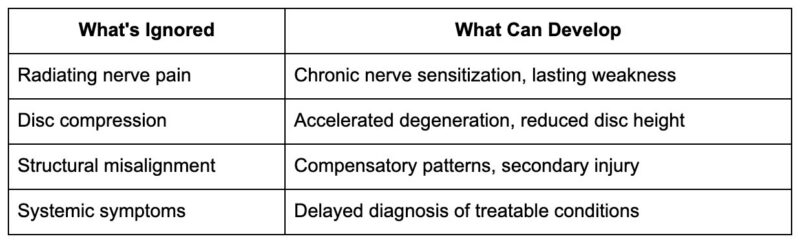
The window for straightforward correction is always widest early. Waiting rarely simplifies the treatment that follows.
When Should You See a Doctor vs. a Chiropractor?
When to See a Medical Doctor First
- You have any of the emergency symptoms listed above
- Pain followed significant trauma
- Unexplained systemic symptoms (fever, weight loss, fatigue) accompany your back pain
- You suspect a fracture, infection, or non-mechanical cause
When Conservative Care May Be Appropriate
- Mechanical or posture-related pain that has persisted beyond 2–4 weeks
- Recurring back pain without red flag symptoms
- Stiffness, limited range of motion, or pain that worsens with certain movements
- Pain that’s disrupting daily life but is not an emergency
A good chiropractor will tell you honestly when your case needs medical referral first. That honesty is part of what makes care trustworthy.
How Chiropractic Care May Help With Non-Emergency Back Pain
For mechanical, posture-driven, or recurring back pain, chiropractic care addresses the structural contributors that keep pain cycling. Specifically, clinically guided care can:
- Restore spinal alignment and improve joint function
- Reduce pressure on irritated nerve roots
- Improve range of motion and movement quality
- Support long-term pain management without medication or surgery
A systematic review by Dr. Paul Shekelle, published in Annals of Internal Medicine, confirmed that spinal manipulation is an effective treatment for acute and subacute low back pain, with outcomes comparable to or better than standard medical care for appropriate cases.
When to See a Chiropractor in Fairfield, CT
These are the clearest signals that a chiropractic evaluation is your next right step:
- Pain has persisted beyond 2–3 weeks without clear improvement
- Back pain is interfering with work, sleep, or daily movement
- Symptoms are recurring on the same pattern
- You want to understand the structural cause – not just manage symptoms
At Southport Chiropractic, as your trusted Chiropractor Fairfield, CT, Dr. Richard Pinsky takes a careful, evidence-based approach to evaluating back pain and distinguishing what needs monitoring from what needs active treatment.
What to Expect at Your First Chiropractic Visit
Your first visit is about understanding – not jumping straight to treatment:
- Detailed health and symptom history – when it started, what makes it better or worse, and what you’ve already tried
- Physical examination – posture, range of motion, neurological screening, and spinal assessment
- A clear report of findings – what we found, what it means, and what a personalized care plan looks like
- Patient education – so you understand your condition and can make an informed decision
No pressure. No guessing. Just clinical clarity.
Listen to Your Body and Take Action Early
Most back pain is manageable. A lot of it resolves with the right support and a little time. But serious back pain symptoms – pain that radiates, persists, worsens, or comes with neurological changes – deserve prompt attention, not patience.
If you’re asking yourself when is back pain serious – the very fact that you’re asking suggests it’s time to get a professional opinion. The sooner you understand what’s driving your symptoms, the sooner you can do something meaningful about it.
Schedule your evaluation today and get a clear clinical picture of what your back is actually telling you.