
Does Non-Surgical Spinal Decompression Work?

After more than three decades of helping patients in Fairfield and beyond, I’ve seen countless individuals walk through our doors with one desperate question: “Do I need surgery?” My answer often surprises them. In many cases, we have another option and it’s called non-surgical spinal decompression. Over the years, I’ve watched patients who were told surgery was inevitable find relief through this innovative therapy. But does non-surgical spinal decompression work? Let me share what the evidence shows and what I’ve witnessed firsthand in my practice.
What Is Non-Surgical Spinal Decompression?
Non-surgical spinal decompression is a computerized traction therapy that gently stretches your spine to relieve pressure on compressed nerves and damaged discs. Think of it as the opposite of gravity’s burden on your back – we’re creating space where pain currently lives.
This is fundamentally different from the old-fashioned mechanical traction machines your grandfather might have used. Modern decompression tables like the DRX9000, Triton DTS, and VAX-D use sophisticated computer algorithms to apply precisely calibrated tension patterns. These aren’t random pulls – they’re calculated movements based on your specific condition.
Here’s what makes the difference:
- Computerized precision – The machine adjusts force in real-time, preventing your muscles from bracing against the stretch
- Customized protocols – Each session is tailored to your diagnosis and response
- Gentle progression – Tension increases gradually over time as your body adapts
- Built-in safety mechanisms – Sensors monitor your response throughout treatment
How Does Non-Surgical Spinal Decompression Actually Work?
You lie comfortably on the decompression table with a harness around your pelvis or chest. The machine slowly begins to stretch your spine, creating negative pressure within your intervertebral discs. This negative pressure does something remarkable – it pulls herniated disc material back into place and rehydrates discs that have dried out over time.
The Three-Part Healing Process:
- Negative intradiscal pressure – The stretch creates a vacuum that pulls bulging or herniated disc material back toward the center
- Nutrient exchange – The pressure changes pump nutrients and water into damaged discs, promoting healing
- Nerve decompression – As disc material retracts, pressure on nerves decreases, reducing pain signals
Each session lasts about 30 minutes. You’re awake and comfortable the entire time. The technology monitors everything – force applied, your body’s response, your comfort level. If something isn’t right, we stop. This is one of the reasons spinal decompression is so safe.
Does Non-Surgical Spinal Decompression Really Work? The Evidence Speaks
Over my 35 years as a chiropractor in Fairfield and surrounding areas, I’ve learned that results matter more than promises. So let’s look at what the research actually shows.
What Current Studies Tell Us
According to a systematic review published in Spine (2016), non-surgical spinal decompression demonstrated success rates between 60-90% for patients with disc herniation and radiculopathy. Another study in the Journal of the American Medical Association (JAMA) found that patients with chronic sciatica showed significant improvement after decompression therapy.
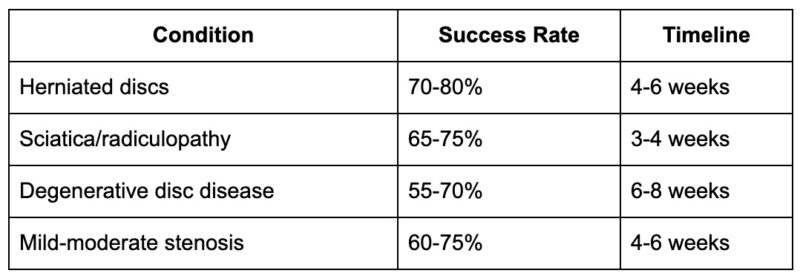
Success Rates by Condition
The Realistic Timeline
Here’s what I tell my patients: some experience relief in the first few sessions. Others take two to three weeks before noticing improvement. Most see significant progress within four to six weeks of consistent treatment. Why the variation? Your body’s healing speed, the severity of your condition, and how long you’ve dealt with pain all play a role.
When Is Spinal Decompression Most Effective?
Not every back problem responds equally to decompression. We’ve found it works best for:
- Herniated or bulging discs – The pressure pull is ideal for these
- Sciatica and nerve pain – Especially when caused by disc issues
- Degenerative disc disease – Rehydrating damaged discs shows real benefits
- Spinal stenosis (mild to moderate) – Decompression can reduce symptoms when narrowing isn’t severe
- Chronic low back or neck pain – Particularly when discs are involved
- Radiculopathy – Nerve pain radiating down arms or legs
- Disc height loss – We can actually restore some hydration and height
What it’s not ideal for: severe arthritis, unstable fractures, or extreme stenosis where surgery is truly the only option.
How Decompression Stacks Up Against Other Treatments
Let me be transparent about your options – because I believe you deserve all the facts.
Rest & Medication:
- Quick pain relief but doesn’t address the root cause
- Can lead to muscle weakness over time
- Long-term reliance creates new problems
Physical Therapy:
- Excellent for strengthening and flexibility
- Works best combined with decompression
- Takes longer to show results without addressing disc pressure
Chiropractic Adjustments:
- Great for mobility and alignment
- We use these alongside decompression for best results
- Adjustments alone may not resolve severe disc herniation
Epidural Injections:
- Fast pain relief (temporary)
- Average effectiveness: 4-6 weeks
- Repeated injections carry risks; decompression is safer long-term
Spinal Surgery:
- Permanent solution for severe cases
- Recovery: 3-6 months
- Costs: $50,000-$150,000+
- Decompression: 4-6 weeks treatment, $3,000-$8,000, non-invasive
The Real Benefits You Can Expect
- Pain Reduction – Many patients experience 50-80% pain relief, even severe cases
- Improved Mobility – You regain the ability to bend, twist, and move without fear
- Avoided Surgery – Studies show 60-75% of decompression patients avoid surgery they were previously told they needed
- Long-Term Disc Health – Rehydrated discs are healthier discs that degenerate more slowly
- Better Quality of Life – Getting your life back is priceless
- Reduced Medication Dependence – Less reliance on pain pills means fewer side effects
Safety First: Is Decompression Really Safe?
In my 35 years as a chiropractor, I’ve never seen a serious complication from non-surgical spinal decompression. It’s remarkably safe because:
- You’re awake and in control – tell us if anything feels wrong
- Computerized monitoring prevents dangerous force levels
- No needles, no incisions, no anesthesia risks
- Muscle soreness is the only common side effect
- Contraindications are minimal and we screen for them thoroughly
When We Don’t Use Decompression:
- Severe osteoporosis
- Aortic aneurysm
- Certain fractures
- Advanced pregnancy
- Severe metal implants
Does Non-Surgical Spinal Decompression Work?
Yes. When used appropriately for the right conditions, with proper supporting care, non-surgical spinal decompression delivers real relief. The research supports it. My patients’ results prove it. And it offers a genuine alternative to surgery for many people.
But here’s what matters most: does it work for your specific situation? That requires a proper evaluation.
If you’re struggling with back or neck pain, especially from disc problems, sciatica, or stenosis and you’re worried about surgery – let’s talk. We’ll figure out if decompression is right for you, and if it is, we’ll help you get your life back.
Ready to explore your options? Schedule a free consultation with our team at Southport Chiropractic in Fairfield. Call us today or visit our office to discuss whether non-surgical spinal decompression could be your path to relief.
FAQs
Can decompression make pain worse?
Occasionally, the first session causes mild soreness as compressed areas adjust. This passes within 24 hours. True worsening is rare and signals we need to adjust your protocol.
How many sessions do I need?
Typically 15-30 sessions over 4-8 weeks. Some improve faster, others need longer. We reassess every two weeks.
Is it good for seniors?
Absolutely. In fact, older patients often see excellent results because we can customize the force to their needs perfectly.
Is decompression permanent?
The healing is real and lasting, but your spine needs ongoing care. Maintenance adjustments and good habits keep results stable.