
Can Sciatica Cause Knee Pain?

At Southport Chiropractic, we see patients almost weekly who come in convinced they have a knee injury – only to discover can sciatica cause knee pain is exactly what’s happening to them. The answer? Absolutely, yes.
Sciatica doesn’t always announce itself with classic lower back pain. Sometimes, it sneaks down your leg and settles right into your knee, making you think you’ve got arthritis or a torn meniscus.
Let’s break down exactly how your sciatic nerve might be behind that nagging knee discomfort.
Understanding the Link Between Sciatica and Knee Pain
The sciatic nerve is the longest nerve in your body – it’s about as thick as your pinkie finger and runs from your lower back all the way down to your toes. Here’s the route it takes:
- Starts at nerve roots L4, L5, and S1 in your lumbar spine
- Travels through your buttocks and hip
- Splits into branches that serve your thigh, knee, calf, and foot
When something compresses this nerve at the spine level – particularly around L3, L4, or L5 – the pain doesn’t always stay put. It radiates. Think of it like a garden hose: pinch it at the top, and the pressure shows up somewhere downstream.
According to research by Dr. Konstantinou and colleagues published in BMJ Open (2015), nearly 40% of sciatica patients report pain below the knee. We’ve found that many people don’t realize their knee pain is nerve-related because the joint itself looks and feels normal. No swelling. No clicking. Just pain that seems to come out of nowhere.
Signs That Your Knee Pain May Actually Be Sciatica
Not sure if what you’re feeling is sciatica knee pain? Here are the telltale signs we look for during examinations:
Classic Sciatica-Related Knee Symptoms:
- Pain that starts in your lower back or buttock and travels down to your knee
- Sharp, electric, or burning sensations (not a dull ache)
- Tingling or “pins and needles” around the knee or down the leg
- Knee buckling or sudden weakness when walking
- Symptoms that worsen when sitting, coughing, or sneezing
- One leg affected more than the other
If you’re nodding along to several of these, there’s a good chance your knee is innocent – your spine is the real source.
Common Causes and Risk Factors Behind Sciatica-Related Knee Pain
What triggers this nerve compression in the first place? We see a variety of culprits:
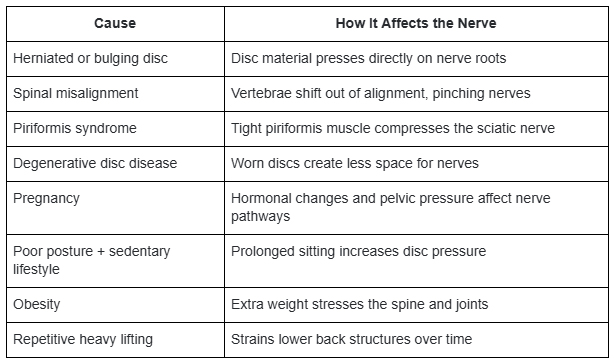
A study by Jensen and team in the New England Journal of Medicine (2013) showed that disc problems are incredibly common – even in people without symptoms. But when you add poor posture or excess weight into the mix, that’s when knee pain from sciatica tends to flare up.
How to Tell If Sciatica Is Causing Your Knee Pain
Here’s where things get interesting. True knee problems and sciatica-related knee pain can feel similar, but they have distinct differences.
Sciatica Pain:
- Travels from back to knee
- Electric or burning quality
- Worsens with back movements or sneezing
- May include tingling or numbness
True Knee Pain:
- Stays localized to the joint
- Aching or grinding sensation
- Worsens with bending, stairs, or kneeling
- May include swelling or stiffness
When patients visit us, we perform neurological exams that test reflexes, muscle strength, and nerve tension. The straight leg raise test is particularly revealing – if lifting your leg while lying down shoots pain down to your knee, we’re likely dealing with nerve compression.
Sometimes imaging like MRI or X-rays helps confirm what’s happening at the spine level, especially if we suspect disc herniation or spinal stenosis.
Other Conditions That Mimic Sciatica-Related Knee Pain
Before you self-diagnose, know that several conditions can masquerade as sciatica pain in knee:
- Osteoarthritis – cartilage wear causes joint pain and stiffness
- Meniscus tear – knee clicking, locking, or giving way
- ACL or MCL strain – injury-related instability
- Bursitis or tendonitis – inflammation around the knee cap
- Patellofemoral pain syndrome – pain behind or around the kneecap
- Hip or pelvic dysfunction – referred pain that mimics sciatica
A proper evaluation helps us differentiate between these issues. Sometimes patients have a combination – a knee problem and sciatica – which requires a more comprehensive treatment approach.
How Chiropractors Treat Sciatica and Nerve-Related Knee Pain
This is where we shine. Chiropractic treatment for sciatica focuses on getting to the root cause – not just masking symptoms with medication.
Our Treatment Approach Includes:
- Comprehensive Evaluation – We assess your spine, posture, and movement patterns
- Gentle Spinal Adjustments – Realigning vertebrae takes pressure off compressed nerves
- Soft Tissue Therapy – Releasing tight muscles (like the piriformis) that contribute to nerve irritation
- Spinal Decompression – Non-surgical technique that creates space for herniated discs to heal
- Corrective Exercises – Strengthening core and leg muscles prevents future episodes
- Lifestyle Coaching – Ergonomic advice for work and daily activities
When to See a Chiropractor or Doctor
Don’t ignore persistent symptoms. Seek help if you experience:
- Knee or leg pain lasting more than 7-10 days
- Numbness or tingling that spreads or worsens
- Weakness in your leg or difficulty controlling your knee
- Pain that returns after surgery
- Loss of bladder or bowel control (seek emergency care immediately)
Early intervention makes a huge difference. The longer nerve compression continues, the more challenging recovery becomes.
FAQs
Can sciatica affect both knees?
Yes, though it’s less common. Bilateral sciatica can occur with central spinal stenosis or severe disc problems affecting multiple nerve roots.
How long does sciatica-related knee pain last?
With proper treatment, most patients see improvement within 4-6 weeks. Chronic cases may take 8-12 weeks or longer.
Is chiropractic treatment safe for sciatica?
Absolutely. Chiropractic care is non-invasive and research-backed. We tailor adjustments to your specific condition and comfort level.
Can sciatica heal without treatment?
Some mild cases resolve on their own, but many people experience recurring episodes. Addressing the underlying cause prevents future problems.
Chiropractic Relief for Sciatica and Knee Pain in Fairfield CT
If you’re tired of guessing whether your knee pain is really a knee problem or something more, we’re here to help. At Southport Chiropractic, we specialize in personalized, non-invasive care that gets to the root of how sciatica affects the knee.
We don’t just treat symptoms – we restore mobility, improve nerve health, and help you get back to pain-free movement.
As a trusted chiropractor Fairfield CT, Dr. Richard Pinsky has helped hundreds of patients find lasting relief without surgery or heavy medications. We focus on natural healing that empowers your body to recover and stay healthy long-term.
Ready to take the next step? If knee pain is stopping you from living comfortably, schedule your personalized sciatica assessment today at Southport Chiropractic in Fairfield CT. Let’s figure out what’s really going on and create a plan to get you moving freely again.