Laser Therapy vs Cortisone Injections: Which Is Right for You?
If you are dealing with ongoing joint, muscle, or tendon pain, you may have come across two common treatment options: laser therapy vs cortisone injections. Both are used to reduce pain and improve function, but they work in very different ways.
Understanding these differences can help you have a more informed discussion with your healthcare provider. The best treatment depends on your diagnosis, the severity of your symptoms, your health history, and your personal goals.
What is deep tissue laser therapy?
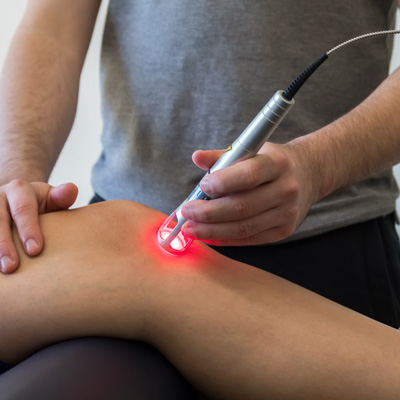
Deep tissue laser therapy aims focused light at an injured area. The light sits in the red and near infrared range, and researchers call the effect photobiomodulation.
The light passes through skin and reaches the tissue underneath. Inside your cells it is taken up by the part that makes energy. Cells with more energy to spend repair faster, and the swelling around them settles.
Nothing is injected and nothing is cut. You feel a mild warmth on the skin and nothing else. A session runs about five to fifteen minutes depending on the area.
The key point is that it nudges your own repair process along. It does not switch inflammation off. That one difference explains almost everything below.
Laser therapy vs cortisone injections: key differences
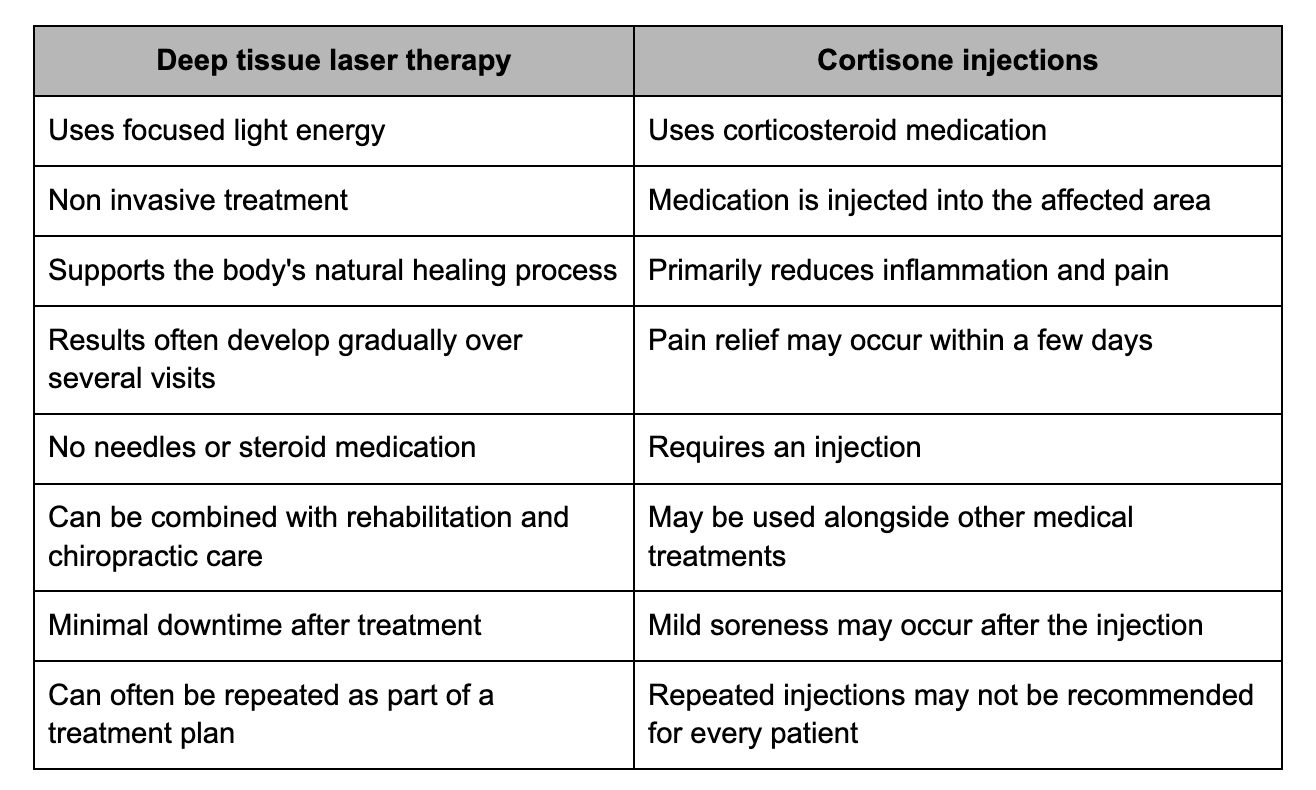
Now the parts a table cannot say properly.
How they work
Cortisone is a strong anti-inflammatory drug placed exactly where it hurts. It works by suppression. Laser adds energy to cells and lets your body do the rest.
One borrows relief from your inflammatory response. The other tries to shorten how long you need that response at all.
Pain relief timeline
If you need to be functional by Friday, cortisone wins and it is not close. Relief often arrives within a week.
Lasers are slower and cumulative. Most people notice a change somewhere around the third or fourth session, and the gains stack from there. If your problem has been building for eight months, a few weeks is a fair trade.
Benefits and limitations
Cortisone gives you a window. Whether that window gets used well depends on what you do with it, because the injection itself does not repair anything.
Laser has the opposite profile. Slower, but it works on the tissue rather than the signal. Its limit is worth saying plainly. The research leans positive, but the certainty is low. Reviews keep finding lower pain scores and keep concluding it works best beside other care, not instead of it.
Side effects and recovery
This is where the two separate most sharply.
The light side is short. Very few side effects get reported, everyone in the room wears eye goggles, and a small list of areas gets skipped.
None of that makes cortisone a bad treatment. It makes it a treatment with a budget.
Which conditions may benefit from laser therapy?
The research base is strongest for these:
Knee osteoarthritis. Reviews report meaningful pain reduction, though usually as an add on to exercise rather than a replacement for it.
Tendon problems. Tennis elbow, rotator cuff irritation, Achilles pain, plantar fasciitis. These are also the conditions where repeated cortisone is most questioned.
Neck and low back pain. A well known Lancet analysis found laser more effective than placebo for neck pain in the short and medium term.
Soft tissue injuries. Strains, sprains, and post surgical recovery, where the goal is faster tissue repair.
It is not for everything. If your pain comes from something that needs surgery, no amount of light will fix it, and we will tell you so.
Is laser therapy a good alternative to cortisone injections?
For some people, deep tissue laser therapy may be a good non-invasive option before considering injections. For others, cortisone injections may still be appropriate depending on the diagnosis and the severity of inflammation.
Rather than asking which treatment is better, it is more helpful to ask which treatment best matches your condition.
Laser therapy may be considered when the goal is to support tissue healing while reducing pain and inflammation without medication. Because it is non-invasive, many patients prefer this approach when looking for a conservative treatment that fits into a long term recovery plan.
Cortisone injections may be recommended when inflammation is severe and pain is making it difficult to move or participate in rehabilitation. In some cases, reducing inflammation quickly may help patients begin other forms of treatment more comfortably.
It is also important to remember that these treatments are not always direct alternatives. They are designed for different situations, and the decision should be based on a thorough evaluation rather than symptoms alone.
Your healthcare provider will consider several factors before making a recommendation, including:
- The source of your pain
- How long your symptoms have been present
- The severity of inflammation
- Your overall health and medical history
- Previous treatments and how well they worked
- Your personal treatment goals
A personalized evaluation helps ensure that treatment focuses on the cause of the problem rather than only temporary symptom relief.
See more: Deep Tissue Laser Therapy Cost: What You Can Expect to Pay in 2026
Why choose Southport Chiropractic for laser therapy?
At Southport Chiropractic, every treatment begins with understanding why your pain developed. Dr. Richard Pinsky and Dr. Cathy Brodows evaluate your symptoms, movement, and overall musculoskeletal health before recommending care.
When appropriate, deep tissue laser therapy is combined with chiropractic adjustments and other conservative treatments to help reduce pain, improve mobility, and support the body’s natural healing process. Rather than relying on a single treatment, care is tailored to each patient’s condition and recovery goals.
Start with the $69 new patient special. It covers the consultation, a full chiropractic and orthopedic exam, and a report of findings, so you know what is wrong before anyone recommends anything.
Final thoughts
When comparing laser therapy vs cortisone injections, there is no one size fits all answer. Both treatments can help manage musculoskeletal pain, but they work in different ways and may be appropriate for different conditions.
The most important step is getting an accurate diagnosis. Once the cause of your pain is identified, your healthcare provider can recommend the treatment approach that best supports your recovery and long term goals.
If you are looking for a non-invasive option for persistent muscle, joint, or soft tissue pain, schedule an evaluation at Southport Chiropractic to find out whether deep tissue laser therapy may be right for you.
Frequently asked questions
Is laser therapy more effective than cortisone injections?
Neither treatment is universally better. Laser therapy and cortisone injections serve different purposes. The most appropriate option depends on your diagnosis, the severity of your symptoms, and your treatment goals.
Does laser therapy hurt?
Most patients find laser therapy comfortable. During treatment, you may notice a gentle warming sensation, but the procedure is generally well tolerated and does not require needles or anesthesia.
Can laser therapy be combined with chiropractic care?
Yes. Laser therapy is often used alongside chiropractic adjustments, rehabilitation exercises, and other conservative treatments to help reduce pain, improve movement, and support recovery.