
How to Prevent a Herniated Disc: 5 Expert Strategies for Spinal Longevity
Learning how to prevent a herniated disc isn’t about avoiding all activity or wrapping yourself in bubble wrap. It’s about understanding spinal biomechanics and implementing specific strategies that protect your discs from the forces that cause herniation.
Let’s explore five expert strategies for lifelong spinal health.
1. Master the “Hip Hinge” for Safe Lifting
“Bend your knees” is incomplete advice. The real key to how to prevent a herniated disc during lifting is mastering the hip hinge – a movement pattern that keeps your spine neutral while your hips do the work.
Why the hip hinge protects your discs: When you bend at the waist with a rounded back, you create tremendous shearing force on your lumbar discs. The front of each disc compresses while the back stretches – exactly the stress pattern that causes herniation.
Proper hip hinge technique:
- Feet shoulder-width apart: Stable base of support
- Maintain neutral spine: Natural curves intact, not rounded
- Push hips backward: Like closing a car door with your butt
- Knees bend slightly: Not a squat, just soft knees
- Chest stays up: Shoulders back, core engaged
- Load close to body: Never reach and twist
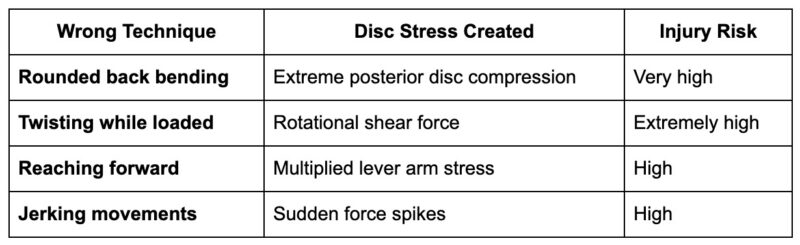
Common lifting mistakes causing disc injury:
2. Prioritize Core “Stiffness” Over Core “Strength”
Most people think sit-ups and crunches build a healthy back. Actually, these flexion-based exercises create the same disc stress that causes herniations.
The stiffness vs. strength distinction: Your core’s job isn’t to create movement – it’s to resist movement and maintain spinal stability under load. This requires stiffness (bracing ability), not just strength.
Best exercises for disc protection:
Planks (front and side):
- Create anti-extension and anti-lateral flexion strength
- Teach whole-body tension patterns
- Build endurance without spinal flexion
- Progress by adding duration, not reps
Bird dogs:
- Challenge anti-rotation stability
- Improve hip-spine coordination
- Build unilateral control
- Enhance proprioception
Dead bugs:
- Anti-extension core control
- Safe supine progression
- Teaches limb dissociation from trunk
- Excellent for beginners
Pallof press:
- Pure anti-rotation training
- Functional standing stability
- Scalable resistance
- Sport-specific transfer
3. Optimize Spinal Alignment to Balance Disc Pressure
Here’s what most people don’t realize about how to prevent a herniated disc: if your spine is chronically misaligned, one side of each disc bears 70-80% of the load while the opposite side experiences almost no pressure.
The uneven loading problem: Imagine placing weight on only one corner of a book. Eventually, that corner crushes while the opposite corner remains pristine. Your discs experience the same phenomenon with chronic misalignment.
How regular chiropractic adjustments prevent herniation:
- Restore balanced weight distribution across disc surfaces
- Reduce excessive stress concentration
- Maintain optimal spinal mechanics
- Prevent compensatory patterns that overload specific segments
At our chiropractor Fairfield practice, we use precise spinal analysis to identify and correct misalignments before they create disc damage. This proactive approach prevents problems rather than treating them after herniation occurs.
4. Combat “Sedentary Compression” with Micro-Movements
Sitting is gravity-based compression torture for your discs. Every hour spent in a chair slowly squeezes fluid out of your discs like wringing water from a sponge.
The sitting problem: When you sit, intradiscal pressure increases 40% compared to standing. Prolonged sitting without position changes creates constant compression that dehydrates discs and makes them vulnerable to injury.
30-second decompression strategies:
Every 30 minutes, perform one:
- Stand and reach overhead (decompress spine)
- Gentle backward bending (reverse flexion stress)
- Hip circles (mobilize pelvis and lower back)
- Walk 50 steps (restore natural spinal curves)
Workspace ergonomic essentials:
- Monitor at eye level: Prevents forward head posture
- Feet flat on floor: Maintains pelvic positioning
- Lumbar support: Preserves lower back curve
- Keyboard/mouse close: Reduces reaching stress
- Standing desk option: Alternate sitting/standing
5. Support Disc Hydration Through Nutrition & Lifestyle
Discs don’t have direct blood supply – they get nutrients through osmosis from surrounding tissues. This makes them uniquely vulnerable to anything that impairs circulation or hydration.
Nicotine’s devastating disc effect: Smoking constricts blood vessels, reducing nutrient delivery to spinal structures by up to 50%. Smokers experience disc degeneration at significantly younger ages than non-smokers.
Critical disc nutrition factors:
Hydration:
- Discs are 80% water when healthy
- Dehydration reduces disc height and shock absorption
- Drink minimum half your body weight in ounces daily
- More during exercise or heat exposure
Anti-inflammatory nutrition:
- Omega-3 fatty acids (fish, flaxseed, walnuts)
- Colorful vegetables (antioxidants)
- Adequate protein (tissue repair)
- Limit processed foods and sugar (pro-inflammatory)
Smoking cessation:
- Single most important lifestyle change for disc health
- Benefits begin within weeks of quitting
- Partial reversal of damage possible with long-term cessation
Protect Your Discs, Protect Your Future
Understanding how to prevent a herniated disc empowers you to take control of your spinal health before a crisis hits.
At Southport Chiropractic, we specialize in proactive spinal care that prevents disc problems before they require aggressive intervention. Prevention beats treatment – always.
Ready to protect your spine for the long haul? Take advantage of our $49 Initial Consultation Special today. We’ll assess your current disc health, identify your specific risk factors, and create a personalized prevention plan keeping you active and pain-free for decades. Your discs will thank you – for life.
See more: Can a Chiropractor Fix a Bulging Disc?